Every day we read a book together. The books vary from silly to thoughtful to philosophical to informative. Throughout the story I will stop from time to time to ask students questions, and they will turn to their reading buddy and share their responses to the questions while I listen in to their conversations. For those non-education folk, it's a process called "Interactive Read Aloud" the interactive part being when students get to respond to the story, not just listen to it. I have some personal favorites I like to share, like Spoon, The Dot, and Bill and Pete (a crowd pleaser, since the poaching villian is seen running away butt naked after being scared off from his bath by the crocodile he had originally captured for suitcase skins)
However, I recently discovered a lovely book called Press Here. Each page gives a direction, and then upon turning the page the shape, size, and placements of the dots change seemingly in response to the reader's action. Not only is the book a brilliant way to teach following directions, it is also a delightful read aloud. Last Friday I read it to my students. No, it wasn't rigorous, but each student got to have a chance interacting with the book as I jogged from person to person and they tilted, tapped, and rubbed the book. At the end, I briefly mentioned that a book doesn't have to be hard and frustrating in order to be fun. (I have a LOT of readers trying to read books FAR too challenging for them, as evidenced today when one student entered the room exclaiming, "Mrs. Swanson, I'm reading Moby Dick!!")
At the end of every Friday we also have a chance for students to reflect on their week in the form of a weekly letter. It is something I did with my seventh graders my first year teaching, and I decided to bring it back this year with my third graders. On fancy and fun paper, students respond to three prompts: One thing I thought went well this week was... One thing I thought didn't go well was... My big goal for next week is... Students will respond to varying levels of depth and thought, and the letters are quite enjoyable to read and respond to over the weekend. The students are always excited to come in the room on Monday morning to find a colorful envelope on their desks.
Last Friday, I was especially touched by one girl's letter. This is a student who has been very kind from the first day of school. When other mope and moan, she smiles and participates. She can be somewhat of a tattle tale if someone isn't shaping up to her standards, but she is a dearheart who invited every student in the classroom to her birthday pool party, and who gives her partner a high five if they have done well. Her mom should be extremely proud of her. It's even more impressive because this little girl has some significant health issues that have meant she has had to be prodded by doctors and has long term effects on her life choices. However, she never complains and never expects special treatment.
Therefore, I was so amazed at reading her letter:
Dear Ms. Swanson,
One thing I thought went well this week was: "thank you for reading Press Hear". Everybody loves the book, even me!
One thing that didn't go well this week was: "I did not have a chance to press, sake, or tip the book and my brother did not give me a gift"
My big goal for next week is: be happy for someone who gets picked for working hard.
Love,
Angie
OK, besides making me feeling TERRIBLE for not picking her (I thought I got everyone!) I think this is the most adorable thing that makes me want to go out and hug the whole world and love everyone just a little bit more. I want to be happy for people who get celebrated, and I swear that if I become more able to be happy for those who are happy, it will be in part because of Angie.
Monday, August 29, 2011

Wednesday, August 17, 2011
reason #8: the quotes... seriously, the quotes
OK, nothing too deep today, although there was a moment when one of my students started crying that I almost cried with him, and I remembered again how powerful and challenging it is to teach.
Later, the same child was upset because another child had said something mean about him. The conversation:
Peter: I'm mad cuz he said all sorts of mean stuff about me, stuff I don't even wanna repeat.
Leo: I didn't say nothin about him.
Peter: Yes, you did. You said that my eyes are slanty and that my eyebrows come together and make one eyebrow. And I can't help that! A lot of people have only one eyebrow! I don't think you should make fun of me because of that.
Me: Leo, did you said that Peter only has one eyebrow?
Leo: Yes.
Me: Please apologize.
(apology)
Me: OK, now we either need to handshake, high five, or hug.
(handshake, Leo sits down)
Peter: There's still something between us, cuz nobody gets to talk about my eyebrows like that!
Seriously, how did I not laugh?
Later, the same child was upset because another child had said something mean about him. The conversation:
Peter: I'm mad cuz he said all sorts of mean stuff about me, stuff I don't even wanna repeat.
Leo: I didn't say nothin about him.
Peter: Yes, you did. You said that my eyes are slanty and that my eyebrows come together and make one eyebrow. And I can't help that! A lot of people have only one eyebrow! I don't think you should make fun of me because of that.
Me: Leo, did you said that Peter only has one eyebrow?
Leo: Yes.
Me: Please apologize.
(apology)
Me: OK, now we either need to handshake, high five, or hug.
(handshake, Leo sits down)
Peter: There's still something between us, cuz nobody gets to talk about my eyebrows like that!
Seriously, how did I not laugh?
Tuesday, August 9, 2011
reason #7: They give you hope for the future
Our school has implemented a new behavior policy this year. For the past five years I have been using some variation on the theme of color changes. Basically, if you do something wrong you get a "color change" which ideally correlates to some consequence, and also teaches students basic traffic light understanding years before they fail their driving tests. The color system is far from perfect. More than once I have been tempted to yell "who gives a flying -*(#$ about your color getting changed?!?! IT'S JUST A COLOR! STOP CRYING!" to a child who has overreacted to me moving their clothespin from green to yellow. However, knowing the danger of undermining my own management system, I have refrained from such outbursts.
But I digress. Our new behavior management system is called "Responsive Classroom." The basic principle is that children must learn to internalize appropriate norms of behavior so that they can be polite, productive citizens in the classroom. The three consequences you follow in RC are: 1.) You break it-you fix it, 2.) Take a break, 3.) Loss of privilege. These are not necessarily consecutive. For example, a child who climbs up the slide will need to sit out from recess for several minutes to have a conversation about why we have rules on the playground. (By the way, this lead to tears and a child holding a grudge for DAYS after he lost two minutes of recess privilege... DAYS!) (Also by the way, I can't be the only person wishing more adults would abide by "you break it-you fix it)
The consequences are thought of as "logical consequences" that are both responsive to the behavior, but are not punitive and are ultimately instructive of what should happen in the future. Ideally, consequences match the behavior in both deed and severity. (A child who draws on his desk will clean his desk, not the whole classroom.) I have not kept my cool at every moment of every one of the last seven days, but I do have to say that I have been very pleased to see my students "taking breaks" when they need them without prompting, and overall pretty polite behaviors. After years of seeing teachers futility attempting to wield external control, I like the idea that I could be part of rearing citizens who think. Therefore, I have dubbed responsive classroom "How Not to Raise a Tea Party Activist."
I wasn't totally sold on the success of this program, in spite of agreeing whole-heartedly to its missions and goals, until the other day. Marco was sitting in his desk, hands folded, with red DRANK on his desk. Yes, drank. Do not get me started about the not so secret tie between red dyes and kids acting like they came straight from the zoo. While still instructing the class I walked over the Marco's desk, picked up his drank, and threw it into the trash can. I did this seemlessly, with the expertise only a veteran can manage. Then again, I took a red drink off of an ADHD kid's desk and threw it into the trash can. It's like taking a beer from a drunk. Honestly, I should know better. We spend so much time talking about the antecedents of negative student behavior, and I'm pretty sure throwing a highly volatile kid's drink in the trash guarantees negative behavior.
As soon as I moved away, I saw Marco tensing up. Fists clenched, brows furrowed, he was on the peek of a true meltdown. Then suddenly, as if by magic, he grabbed his chair, whipped it over to our "take a break" station, and sat down to do our breathing exercises. While I continued to teach, never breaking my stride, he sat and calmed himself down. Within a minute he quietly moved his chair back to his seat and returned to doing his work.
I think this was one of the more amazing moments of my teaching career. Without prompting, begging, arguing, or disrupting, Marco was able to self soothe and return to work.
I admit, I cried a little when they told me I couldn't have my stop light up in the classroom this year. My heals may have dug slightly into the asbestos tiles. I was a little like the crusty and curmudgeonly teacher held up as the example of why schools are failing. But Marco has given me hope that change can be good, and that in spite of government shut downs and riots in London a new generation will rise up...and hopefully they were taught in responsive classrooms.
But I digress. Our new behavior management system is called "Responsive Classroom." The basic principle is that children must learn to internalize appropriate norms of behavior so that they can be polite, productive citizens in the classroom. The three consequences you follow in RC are: 1.) You break it-you fix it, 2.) Take a break, 3.) Loss of privilege. These are not necessarily consecutive. For example, a child who climbs up the slide will need to sit out from recess for several minutes to have a conversation about why we have rules on the playground. (By the way, this lead to tears and a child holding a grudge for DAYS after he lost two minutes of recess privilege... DAYS!) (Also by the way, I can't be the only person wishing more adults would abide by "you break it-you fix it)
The consequences are thought of as "logical consequences" that are both responsive to the behavior, but are not punitive and are ultimately instructive of what should happen in the future. Ideally, consequences match the behavior in both deed and severity. (A child who draws on his desk will clean his desk, not the whole classroom.) I have not kept my cool at every moment of every one of the last seven days, but I do have to say that I have been very pleased to see my students "taking breaks" when they need them without prompting, and overall pretty polite behaviors. After years of seeing teachers futility attempting to wield external control, I like the idea that I could be part of rearing citizens who think. Therefore, I have dubbed responsive classroom "How Not to Raise a Tea Party Activist."
I wasn't totally sold on the success of this program, in spite of agreeing whole-heartedly to its missions and goals, until the other day. Marco was sitting in his desk, hands folded, with red DRANK on his desk. Yes, drank. Do not get me started about the not so secret tie between red dyes and kids acting like they came straight from the zoo. While still instructing the class I walked over the Marco's desk, picked up his drank, and threw it into the trash can. I did this seemlessly, with the expertise only a veteran can manage. Then again, I took a red drink off of an ADHD kid's desk and threw it into the trash can. It's like taking a beer from a drunk. Honestly, I should know better. We spend so much time talking about the antecedents of negative student behavior, and I'm pretty sure throwing a highly volatile kid's drink in the trash guarantees negative behavior.
As soon as I moved away, I saw Marco tensing up. Fists clenched, brows furrowed, he was on the peek of a true meltdown. Then suddenly, as if by magic, he grabbed his chair, whipped it over to our "take a break" station, and sat down to do our breathing exercises. While I continued to teach, never breaking my stride, he sat and calmed himself down. Within a minute he quietly moved his chair back to his seat and returned to doing his work.
I think this was one of the more amazing moments of my teaching career. Without prompting, begging, arguing, or disrupting, Marco was able to self soothe and return to work.
I admit, I cried a little when they told me I couldn't have my stop light up in the classroom this year. My heals may have dug slightly into the asbestos tiles. I was a little like the crusty and curmudgeonly teacher held up as the example of why schools are failing. But Marco has given me hope that change can be good, and that in spite of government shut downs and riots in London a new generation will rise up...and hopefully they were taught in responsive classrooms.
Wednesday, August 3, 2011
Reason #6: They Believe You
A new year has begun full of brand new notebooks and pencils with sharp lead and full pink erasers. The first few days are always fun as you work your way through the honeymoon of getting to know you and community building. However, some students have needs such that even the promise of a fresh new year isn't enough to whip them into shape.
The student I am speaking of is Marco. Marco is a squirmy noodle with the impulse control of a dog spotting a squirrel. He desperately tries to sit still, only to beat box and whip his body around ten seconds after redirection. He is one of the four students in my room this year with ADHD, a label I am starting to believe is available for purchase with a party-sized bag of Flaming Hot Cheetos.
Marco came up to me on the second day of school to inform me that his butt wouldn't stop itching. I told him that he could go to the bathroom to take care of it. Returning a good while later he asked me if he could speak to me. I told him yes. He asked if we could speak in private, his eyes pleading. I scooted a few inches away from the student conference I was conducting and asked him what he needed.
"Mr. N told me that the reason why my butt is itching is because I don't wash good. And he said if I don't wash good, mold will grow on my butt. And he said when that happens the doctor will have to look at it, and then they're gonna cut off my butt."
It was a statement of fact and also a question. (By the way, just as there is no comprehensive manual for parenting, there is also no class or course that prepares you for how to respond to these comments, or how to conduct conversations such as this one with a straight face.) I let him know that I didn't think it would be a problem because I knew that he would clean himself well tonight when he got home.
Two hours later, Marco came up to me, tears brimming, saying his butt itched again and could he please call his mom to go home. Seeing an opportunity for growth, I asked my resident teacher if she would please take Marco into the hallway to call his mother. A true trooper, she came in five minutes later, grabbed a full roll of paper towels, and walked with Marco to the bathroom to help him take care of his "issue". Later, she told me that it is really a unique feeling to call a child's mother and tell her that her son won't stop scratching his ass.
Marco was much better today, medicated anti-itch cream in hand, and excited to toss it up in the air during our morning meeting, a squiggle worm once more. It got me to thinking. There's something truly innocent and sweet about a boy who really believes that a doctor would cut off his butt. While I was annoyed with my coworker (and slightly amused) for his warning, it does make me wonder what else I might say that my students will believe, and whether I should use my words so flippantly.
Then again, maybe if I threaten Marco with cutting off his arms he might sit still?
The student I am speaking of is Marco. Marco is a squirmy noodle with the impulse control of a dog spotting a squirrel. He desperately tries to sit still, only to beat box and whip his body around ten seconds after redirection. He is one of the four students in my room this year with ADHD, a label I am starting to believe is available for purchase with a party-sized bag of Flaming Hot Cheetos.
Marco came up to me on the second day of school to inform me that his butt wouldn't stop itching. I told him that he could go to the bathroom to take care of it. Returning a good while later he asked me if he could speak to me. I told him yes. He asked if we could speak in private, his eyes pleading. I scooted a few inches away from the student conference I was conducting and asked him what he needed.
"Mr. N told me that the reason why my butt is itching is because I don't wash good. And he said if I don't wash good, mold will grow on my butt. And he said when that happens the doctor will have to look at it, and then they're gonna cut off my butt."
It was a statement of fact and also a question. (By the way, just as there is no comprehensive manual for parenting, there is also no class or course that prepares you for how to respond to these comments, or how to conduct conversations such as this one with a straight face.) I let him know that I didn't think it would be a problem because I knew that he would clean himself well tonight when he got home.
Two hours later, Marco came up to me, tears brimming, saying his butt itched again and could he please call his mom to go home. Seeing an opportunity for growth, I asked my resident teacher if she would please take Marco into the hallway to call his mother. A true trooper, she came in five minutes later, grabbed a full roll of paper towels, and walked with Marco to the bathroom to help him take care of his "issue". Later, she told me that it is really a unique feeling to call a child's mother and tell her that her son won't stop scratching his ass.
Marco was much better today, medicated anti-itch cream in hand, and excited to toss it up in the air during our morning meeting, a squiggle worm once more. It got me to thinking. There's something truly innocent and sweet about a boy who really believes that a doctor would cut off his butt. While I was annoyed with my coworker (and slightly amused) for his warning, it does make me wonder what else I might say that my students will believe, and whether I should use my words so flippantly.
Then again, maybe if I threaten Marco with cutting off his arms he might sit still?
Friday, April 1, 2011
#5: They teach you how to give
Two weeks ago the apartment of one of my students burned down. The family lost everything they owned and are currently looking for housing in the neighborhood. The little girl in my room inhaled enough smoke that she had to be resuscitated and taken to the emergency room. Thankfully, she is fine and the scabs from the burns on her face are almost gone.
Books could be written about this girl, she is so resilient. Her positive attitude is a lesson to all of us in giving thanks for what we do have instead of being caught up in what we don't have. Looking out over my classroom, it's easy to forget all that each one of the students have gone through, of the ways that they navigate through life, and in the case of this girl, do so with grace.
The response from the students in my classroom has been overwhelming. Students have brought in clothing to help, and they all wanted to make cards to tell her how much they loved her and how happy they are that she is alright. People outside the class have also reached out to donate items and money to get the family back on their feet.
Everywhere we go it seems as though there are opportunities for us to give our money and resources to help someone somewhere. Honestly, it's a little bit numbing when everyone from the cashier at the grocery store to the person ringing a bell on the street has a cause to donate to. Call me hardened, but living and working in an urban environment makes very little shocking and sometimes it's hard to maintain compassion for the suffering.
My students do not share my fatigue and apathy. In the wake of the Haiti earthquake, one of my students brought in an empty pasta jar full of coins that he and his father had been saving for a year to donate to the change drive at our school. It made the two dollar donation I gave at Whole Foods seem a little pathetic. And the part that made it even more amazing is that he was excited, even joyful, to be part of making a difference in the aftermath of the crisis.
Recently the children in our church spoke during announcements to tell us that they were having a bake sale to raise funds for their Heifer Project donations. Together they had been pooling allowances and other minimal income to purchase a flock of ducks, a water buffalo, and some goats. After the service I went to lunch with two of my best friends. In between bites of hummus, my friend said, "God, I teared up today at church watching those kids. I remember what it felt like when I actually thought I could change the world, when I really believed that I could make a difference."
What happens to that idealism? When did I stop believing that the coins in my pasta jar would make a difference to someone thousands of miles away? When did folded up pieces of notebook paper-frills still attached-stop being sufficient as gifts of love and appreciation? How in the world can I possibly get so lost inside myself that I forget to remember that those small details are what make each day worth sticking around for?
I'm still kind of moping around and angry at the world because of the fire that burned down my student's house. The funny thing is is that she isn't. She comes to school eager to learn, like always. You catch her helping her friends during math and complimenting other students during share time. It's humbling to learn such simple things like gratitude from my students, but I can say with confidence that I'm glad that she is our future.
Books could be written about this girl, she is so resilient. Her positive attitude is a lesson to all of us in giving thanks for what we do have instead of being caught up in what we don't have. Looking out over my classroom, it's easy to forget all that each one of the students have gone through, of the ways that they navigate through life, and in the case of this girl, do so with grace.
The response from the students in my classroom has been overwhelming. Students have brought in clothing to help, and they all wanted to make cards to tell her how much they loved her and how happy they are that she is alright. People outside the class have also reached out to donate items and money to get the family back on their feet.
Everywhere we go it seems as though there are opportunities for us to give our money and resources to help someone somewhere. Honestly, it's a little bit numbing when everyone from the cashier at the grocery store to the person ringing a bell on the street has a cause to donate to. Call me hardened, but living and working in an urban environment makes very little shocking and sometimes it's hard to maintain compassion for the suffering.
My students do not share my fatigue and apathy. In the wake of the Haiti earthquake, one of my students brought in an empty pasta jar full of coins that he and his father had been saving for a year to donate to the change drive at our school. It made the two dollar donation I gave at Whole Foods seem a little pathetic. And the part that made it even more amazing is that he was excited, even joyful, to be part of making a difference in the aftermath of the crisis.
Recently the children in our church spoke during announcements to tell us that they were having a bake sale to raise funds for their Heifer Project donations. Together they had been pooling allowances and other minimal income to purchase a flock of ducks, a water buffalo, and some goats. After the service I went to lunch with two of my best friends. In between bites of hummus, my friend said, "God, I teared up today at church watching those kids. I remember what it felt like when I actually thought I could change the world, when I really believed that I could make a difference."
What happens to that idealism? When did I stop believing that the coins in my pasta jar would make a difference to someone thousands of miles away? When did folded up pieces of notebook paper-frills still attached-stop being sufficient as gifts of love and appreciation? How in the world can I possibly get so lost inside myself that I forget to remember that those small details are what make each day worth sticking around for?
I'm still kind of moping around and angry at the world because of the fire that burned down my student's house. The funny thing is is that she isn't. She comes to school eager to learn, like always. You catch her helping her friends during math and complimenting other students during share time. It's humbling to learn such simple things like gratitude from my students, but I can say with confidence that I'm glad that she is our future.
Wednesday, March 30, 2011
way #4: They Will Be Loved
It is a very sad thing to see a child taken away from the school on a stretcher, headed for a mental institution. It is an especially sad thing to see two children taken away in less than a week's period of time.
When all is said and done, fifty percent of my students have special needs. I teach a third grade room with ability levels ranging from kindergarten to fifth grade levels, so small group instruction is not optional for me. However, the greater challenge is how to handle students with emotional needs. I have never before in my teaching career made so many calls to SASS or to DCFS. I witnessed a mother hit her daughter so hard she had a black eye the next day, and I had another mother come in with a bat under her coat so she could discipline her child. There are many views on the line between discipline and abuse, and my own opinions have changed over time. As a mandated reporter, I have a narrower rule I follow.
In the past week two of my students, on separate occasions, have been hospitalized for threatening to kill themselves. These students have been having issues all year, and we have been working to get them what they need using what resources we have.
One of the students has been fascinating to watch. Over the year I have seen behavior charts work to curb his ability to control specific behaviors (sitting in his seat, keeping his hands off others, not touching other students' butts, etc.) but when he is so focused on his behavior, it makes him seemingly incapable of focusing on the learning he needs to do. His mother insists that he doesn't behave those same ways at home (I insist that if I got to plop my students in front of TV and video games all day at home, they wouldn't exhibit those behaviors, either). His mother has been resistant to using medication or finding therapy, since she sees her child's issues as a result of choice.
However, his behavior escalated to the point of needing hospitalization. As I watched him hug his mother goodbye before being taken to the mental health facility, my heart broke for this tiny boy. But at the same time, I felt a little proud of him. He is a survivor. Deep down, I know he needs help, and he knows he needs help, and he was willing to do and threaten whatever it took in order to get the help he needed. He screamed with his behavior what he was not able to say with his words.
Children are amazingly resilient, and persistent, and will keep asking until they get what they want. I think sometimes we try to beat that out of them, and I think that's sad, because in some cases, it's their only chance of being heard.
When all is said and done, fifty percent of my students have special needs. I teach a third grade room with ability levels ranging from kindergarten to fifth grade levels, so small group instruction is not optional for me. However, the greater challenge is how to handle students with emotional needs. I have never before in my teaching career made so many calls to SASS or to DCFS. I witnessed a mother hit her daughter so hard she had a black eye the next day, and I had another mother come in with a bat under her coat so she could discipline her child. There are many views on the line between discipline and abuse, and my own opinions have changed over time. As a mandated reporter, I have a narrower rule I follow.
In the past week two of my students, on separate occasions, have been hospitalized for threatening to kill themselves. These students have been having issues all year, and we have been working to get them what they need using what resources we have.
One of the students has been fascinating to watch. Over the year I have seen behavior charts work to curb his ability to control specific behaviors (sitting in his seat, keeping his hands off others, not touching other students' butts, etc.) but when he is so focused on his behavior, it makes him seemingly incapable of focusing on the learning he needs to do. His mother insists that he doesn't behave those same ways at home (I insist that if I got to plop my students in front of TV and video games all day at home, they wouldn't exhibit those behaviors, either). His mother has been resistant to using medication or finding therapy, since she sees her child's issues as a result of choice.
However, his behavior escalated to the point of needing hospitalization. As I watched him hug his mother goodbye before being taken to the mental health facility, my heart broke for this tiny boy. But at the same time, I felt a little proud of him. He is a survivor. Deep down, I know he needs help, and he knows he needs help, and he was willing to do and threaten whatever it took in order to get the help he needed. He screamed with his behavior what he was not able to say with his words.
Children are amazingly resilient, and persistent, and will keep asking until they get what they want. I think sometimes we try to beat that out of them, and I think that's sad, because in some cases, it's their only chance of being heard.
Sunday, February 27, 2011
way #3: They've Got Street Smarts
Every year come February, panic sets in and school-wide initiatives are put in place to prepare students for the dreaded ISAT. Standardized testing is the much hated but inevitable part of a teacher's job. This year we spent days putting together a unit to teach testing skills to our students and help them to pass this test.
Some facts: in Illinois, the standardized test is the ISAT, or Illinois Standardized Achievement Test. It is required for all students in third through eighth grade to take these tests. The test contains reading, math, and science. Until last year, it also included writing, but due to budget cuts, writing is no longer assessed in Illinois.
Schools are evaluated based on these tests. Schools have to meet AYP, or adequate yearly progress, each year. The goal was for all students to be at grade level by the year 2014. Therefore, if a school missed AYP one year, the next year the bar is set even higher and the school is responsible for both years' growth. This is all thanks to No Child Left Behind. Obviously, all students will not be on grade level by the year 2014 and the result is the need for changes in the legislation.
However, despite the high bar of all students, the scary part is the low bar of what "meets standards" at a grade level. This year, if a student ranks in the 35th percentile for reading or the 27th for math, they will meet standards for grade level. I imagine that I am not the only person who is horrified both because of the low standards for meeting grade level as well as the low numbers of students who meet grade level given the standards.
However, I digress. ISAT prep time can be a nightmare. It is hard to prepare students to take the test while simultaneously trying to expose them to the concepts that will be on the test that are very often completely separate from their life experiences. Case in point, when teaching sixth graders, half of whom were English Language Learners, the reading passage they had to respond to was about loons. Not one student in the class had ever heard of a loon, as loons are not city-dwellers, and the students are hardly spending summers at their parents' lake cabins. (Coming from Minnesota, it made me warm and nostalgic.)
A colleague recently re-framed my thinking when she referred to teaching testing skills as a social justice issue, allowing low income, urban students to access the test material in the same way as their more affluent, less disadvantaged peers.
The good news is that the students come to the table with a lot, even if it isn't always the information you wish they would know. Students are often very knowledgeable about how to live, how to survive, and other street smarts. Students regularly get their "lick" back and punch someone who punched them, regardless of school rules. Students will cough or spit on food so no one touches it. All in all, it can be a little Lord of the Flies.
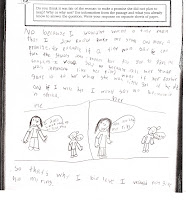
Then again, sometimes it can be hilarious, like the gem of this response. The story was Rumplestiltskin, and the job was for students to respond to whether or not they thought the woman was right in promising Rumplestiltskin her first born child if she didn't plan on actually giving her child to him. While many of the responses left a smile, this one made me laugh out loud. And let's be honest, she's got a point... even if she doesn't meet standards on ISAT.
Some facts: in Illinois, the standardized test is the ISAT, or Illinois Standardized Achievement Test. It is required for all students in third through eighth grade to take these tests. The test contains reading, math, and science. Until last year, it also included writing, but due to budget cuts, writing is no longer assessed in Illinois.
Schools are evaluated based on these tests. Schools have to meet AYP, or adequate yearly progress, each year. The goal was for all students to be at grade level by the year 2014. Therefore, if a school missed AYP one year, the next year the bar is set even higher and the school is responsible for both years' growth. This is all thanks to No Child Left Behind. Obviously, all students will not be on grade level by the year 2014 and the result is the need for changes in the legislation.
However, despite the high bar of all students, the scary part is the low bar of what "meets standards" at a grade level. This year, if a student ranks in the 35th percentile for reading or the 27th for math, they will meet standards for grade level. I imagine that I am not the only person who is horrified both because of the low standards for meeting grade level as well as the low numbers of students who meet grade level given the standards.
However, I digress. ISAT prep time can be a nightmare. It is hard to prepare students to take the test while simultaneously trying to expose them to the concepts that will be on the test that are very often completely separate from their life experiences. Case in point, when teaching sixth graders, half of whom were English Language Learners, the reading passage they had to respond to was about loons. Not one student in the class had ever heard of a loon, as loons are not city-dwellers, and the students are hardly spending summers at their parents' lake cabins. (Coming from Minnesota, it made me warm and nostalgic.)
A colleague recently re-framed my thinking when she referred to teaching testing skills as a social justice issue, allowing low income, urban students to access the test material in the same way as their more affluent, less disadvantaged peers.
The good news is that the students come to the table with a lot, even if it isn't always the information you wish they would know. Students are often very knowledgeable about how to live, how to survive, and other street smarts. Students regularly get their "lick" back and punch someone who punched them, regardless of school rules. Students will cough or spit on food so no one touches it. All in all, it can be a little Lord of the Flies.
Then again, sometimes it can be hilarious, like the gem of this response. The story was Rumplestiltskin, and the job was for students to respond to whether or not they thought the woman was right in promising Rumplestiltskin her first born child if she didn't plan on actually giving her child to him. While many of the responses left a smile, this one made me laugh out loud. And let's be honest, she's got a point... even if she doesn't meet standards on ISAT.

Subscribe to:
Posts (Atom)